
Lee County Arrest Records
Arrest records in Lee County start on the law-enforcement and custody side. The Lee County Sheriff is Joseph C. Lucas, and the county services directory places the sheriff at the courthouse, 256 Main St., Beattyville, with phone 606-464-4120. Beattyville Police Department is listed at City Hall, 28 Railroad St., phone 606-464-5030. The Lee County Jailer is Justin Shuler, and Three Forks Regional Jail serves Lee County custody needs. These offices may have arrest, booking, or jail information that does not appear in a court search the same way.
Local source checks for arrest and charge questions include the KCOJ Lee County court page, the Lee County elected-officials page, and the Lee County services page. Those sources identify the Lee County Courthouse, Circuit Court Clerk Tyler Phillips, Sheriff Joseph C. Lucas, Jailer Justin Shuler, and County Attorney Thomas Hollon.
Charges after arrest become court records when a citation, complaint, information, indictment, warrant return, or related filing reaches the court. District Court handles misdemeanors, violations, traffic offenses, felony arraignments, and felony probable-cause hearings. Circuit Court handles felonies, pleas, trials, sentencing, and post-judgment matters. The formal case file and outcome live in Lee County criminal court records, while the jail roster and booking status belong with inmate records.
Search Lee County Arrest Records
Lee County does not have one official local portal that merges arrests, jail custody, filed charges, criminal case outcomes, and statewide history. Use a channel chain. For filed court charges, start with KYeCourts guest public records and Kentucky ePay. For custody, check Three Forks Regional Jail or call the facility. For statewide court activity, use AOC criminal record reports. For sex-offender registration, use the Kentucky State Police registry, which is a different system from ordinary arrest or charge records.
- Search KYeCourts for public case information after a charge has been filed in District Court or Circuit Court.
- Use ePay for cases, citations, fines, fees, costs, and party searches when the case is payment eligible.
- Call the Lee County Circuit Court Clerk for copies, certified records, older files, and charge-status questions not answered online.
- Use the Three Forks Regional Jail current-inmate URL or phone line for live custody and booking questions.
- Use AOC criminal record reports for a statewide Kentucky court activity screen, not for certified case copies.
The Kentucky State Police sex-offender registry information page explains registry access and alerts for registrants. The registry can be relevant after a qualifying conviction, but it is not a general arrest records database and should not be used as a substitute for court charge lookup.
The KSP registry information page is one manifest source assigned to Lee County arrest and charge records.

That source is best treated as a specialized statewide registry channel, separate from Lee County charge filing and local jail custody.
Lee County Charges After Arrest
A charge record starts with an accusation filed in court. Kentucky terminology in the research includes citation, complaint, information, and indictment. A citation can begin a traffic or misdemeanor matter. A complaint can state the alleged offense. An indictment is a formal felony charge returned by a grand jury. A felony arrest may first appear in District Court for arraignment or probable cause, then move into Circuit Court after indictment.
| Document | Common Use | What to Check |
|---|---|---|
| Complaint | States a criminal allegation and may begin a District Court matter. | Charge language, offense date, court level, defendant name, and case number. |
| Information | Formal charging document used in some criminal proceedings. | Prosecutor filing, amended charge language, and docket updates. |
| Indictment | Formal felony charge returned by a grand jury. | Circuit Court filing, count numbers, felony level, arraignment, and later plea or trial entries. |
Kentucky does not use "district attorney" as the local term. The official county elected-officials page lists Lee County Attorney Thomas Hollon, P.O. Box 116, Beattyville, phone 606-464-9966. County attorneys generally handle many lower-level prosecutions and county legal matters, while Commonwealth's Attorneys prosecute felonies in Circuit Court. A Lee-specific Commonwealth's Attorney page was not confirmed in the research, so no unverified name should be inferred.
Lee County Charge Status
Charge status can change more than once. AOC criminal record reports may show an original charge and amendments to the original charge. A Lee County court record may also show a charge that is pending, dismissed, amended, reduced, transferred, or resolved by plea. Read the docket and disposition before treating an early charge as the final court outcome.
| Status | What It Means |
|---|---|
| Pending | The charge has not reached final disposition, or later docket entries must be reviewed. |
| Amended / reduced | The original charge was changed, corrected, substituted, or reduced before outcome. |
| Dismissed | The court record shows the charge was dismissed, with or without later refiling rights depending on the order. |
| Transferred | The matter moved to another court level, often from District Court to Circuit Court in felony processing. |
| Convicted | The charge ended in a guilty plea, verdict, or other conviction entry followed by sentencing. |
Lee County Charges Versus Convictions
Being charged is not the same as being convicted. An arrest can produce several charges, and each charge can have its own status. Some charges are dropped, dismissed, reduced, amended, or merged into a plea. The court charge record should be read line by line and then checked against the final disposition and sentence.
| Point | Charge | Conviction |
|---|---|---|
| Meaning | Accusation filed after arrest or investigation. | Court outcome after plea, verdict, or qualifying finding. |
| Timing | Early in the case or after amendment. | At disposition and sentencing. |
| Search clue | Original charge, amended charge, charge date, and case number. | Disposition, disposition date, judgment, sentence, and probation entries. |
| Risk | May not reflect final liability. | May still be changed by appeal, vacatur, or expungement when allowed. |
Lee County Custody Notices
Custody status is a separate question from charge status. Kentucky DOC says VINE gathers data from jail booking systems, prisons, mental-health facilities, and juvenile detention centers and sends custody notifications about release, transfer, escape, and parole hearings. VINELink is useful when the question is "is this person still in custody," while KYeCourts and the clerk are better for "what charge was filed and how did the court rule."
The Kentucky VINELink portal is assigned to this arrest and charge page in the image manifest.

VINELink supports custody searches and notifications, but it does not certify Lee County court charge records or replace the Circuit Court Clerk.
The Kentucky DOC VINE information page is another assigned source for custody-notification context.
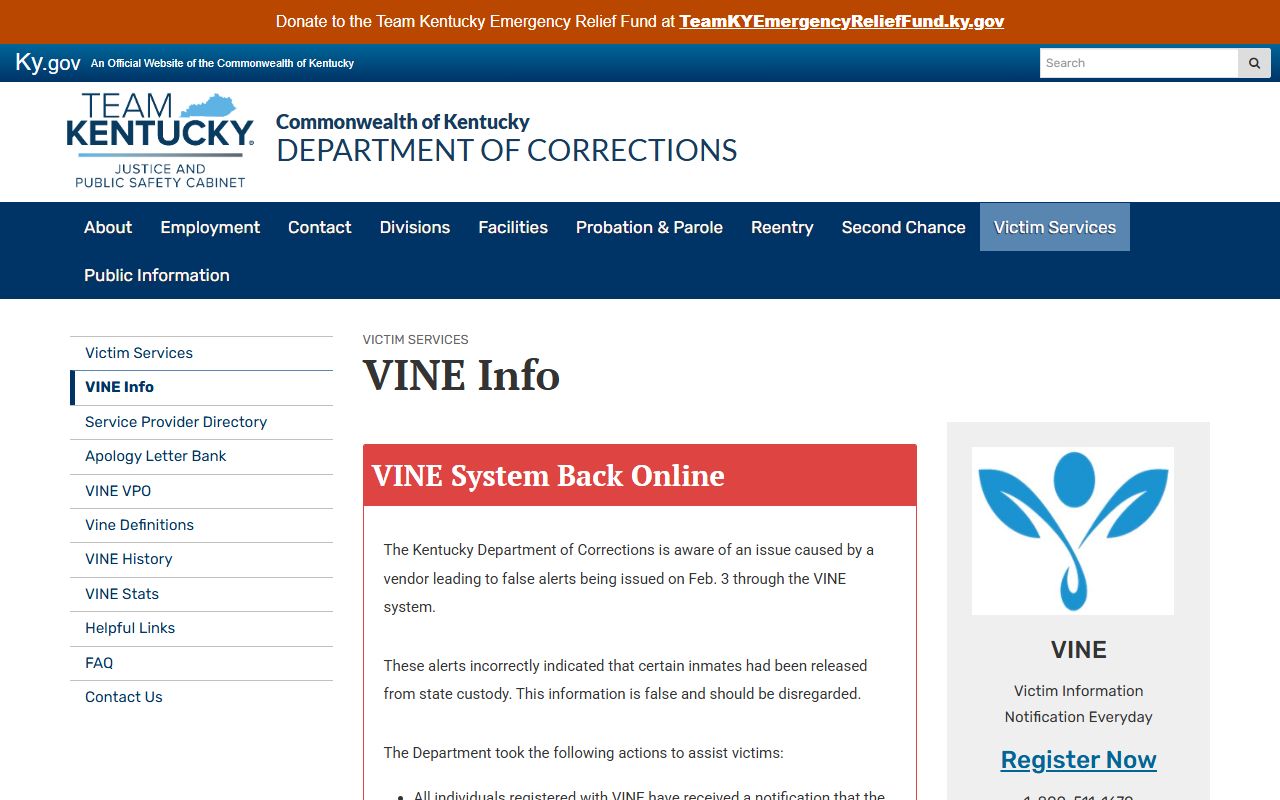
That source supports the custody-notification channel, especially where the jail roster or court docket alone does not answer release or transfer questions.
Lee County Expunged Charges
Charge records may be restricted by sealing, expungement, juvenile confidentiality, or law-enforcement exemptions. AOC criminal record reports exclude juvenile cases, mental-health cases, and domestic-violence cases. KRS 17.150 also limits certain law-enforcement reports, especially investigative material and juvenile identity details. The court may also redact Social Security numbers, financial details, minor identifiers, and exempt private data.
| Point | Sealed | Expunged |
|---|---|---|
| Access | Public access is restricted by law or court order. | Records are removed or deleted from covered systems after statutory steps. |
| Effect | The case may still exist, but ordinary public searches may not show it. | Agencies generally answer that no record exists after expungement takes effect. |
| Kentucky source | KRS 61.878 and court orders can support withholding exempt information. | KRS 431.073 and KRS 431.079 describe felony expungement and the definition of expungement. |
Lee County Charge Access Rules
Kentucky's Open Records Act gives a path for public records requests, but it does not make every arrest detail or charge-related document public at all times. KRS 61.871 states the open-records policy. KRS 61.872 permits requests by hand delivery, mail, fax, or email to the official custodian. KRS 17.150 allows withholding some law-enforcement investigative records and says centralized criminal history is not open for public inspection.
A charge filed in a public court case is usually searched through KYeCourts, ePay, or the Lee County Circuit Court Clerk. Booking data or arrest reports may require the sheriff, jailer, or police department, subject to exemptions. If the question is about public defense appointment, Kentucky uses the Department of Public Advocacy rather than a Lee County public defender office. Appointment questions should be raised at first appearance or through the court.
Note: A statewide criminal history report is not the same document as a certified Lee County court charge record.
Restricted Lee County Charge Records
Do not assume a missing charge record means no arrest occurred. A record can be sealed, expunged, juvenile, pending in another county, withheld during investigation, or stored outside the easy online search path. In Lee County, a practical search may require KYeCourts, ePay, the Circuit Court Clerk, the sheriff, Three Forks Regional Jail, KOOL, and VINELink, depending on whether the goal is court charge status, custody status, or statewide offender status.
When facts conflict, the court file controls the legal case outcome. Use the clerk for certified copies and final dispositions. Use jail and custody tools to check current confinement. Use law-enforcement contacts for arrest records and incident-report questions that have not become court-file documents.